Abstract
Polymethyl methacrylate (PMMA) is widely used in denture base fabrication; however, its relatively low flexural strength (FS) and durability limit long-term clinical performance. Reinforcing with nanofillers such as Halloysite nanotubes (HNTs) has emerged as a promising strategy to enhance the material's mechanical properties. This study aimed to evaluate the effect of different HNT loadings on the FS and surface hardness (VH) of PMMA denture base composites. PMMA composites were prepared using a heat-polymerised resin reinforced with treated HNTs at concentrations of 0, 1, 3, 5, 7, and 9 wt.%. To achieve uniform dispersion, the nanofillers were ultrasonically dispersed in methyl methacrylate before conventional polymerisation; the filler distribution and the effectiveness of silane functionalisation were examined through morphological and microchemical characterisation using scanning electron microscopy (SEM) coupled with energy-dispersive X-ray spectroscopy (EDX). Mechanical performance was assessed by determining FS via the three-point bending test, while VH was measured using the Vickers hardness method. Statistical analysis one-way Analysis of Variance (ANOVA) followed by Tukey’s post hoc test, with significance set at p < 0.05 was performed, confirming that incorporating silane-treated HNTs significantly affected both tested properties (p < 0.05), with the highest values for FS (98.1 MPa) and hardness (20.20 kg/mm2) observed at 5 wt% HNT loading, representing substantial improvements over unmodified PMMA. At higher concentrations (7-9 wt.%), a decline in properties was observed, attributed to nanoparticle agglomeration and reduced interfacial efficiency. HNT reinforcement effectively enhances the mechanical performance of PMMA denture base materials, with 5 wt.% identified as the optimal concentration. These findings support the potential application of HNT-reinforced PMMA to improve durability and clinical longevity of denture prostheses.
Keywords
PMMA, Halloysite Nanotubes, Denture Base, Flexural Strength, Vickers Hardness, Nanocomposites
1. Introduction
In recent decades, advances in dental biomaterials have significantly improved the properties and clinical performance of restorative materials and techniques. A central focus has been on developing new substances with superior biological compatibility and mechanical strength. Incorporating nanotechnology and using advanced ceramics, such as zirconia, have notably enhanced durability, resilience, and biological compatibility compared with conventional options
| [1] | Abozaid D, Azab A, Bahnsawy MA, et al. Bioactive restorative materials in dentistry: a comprehensive review of mechanisms, clinical applications, and future directions. Odontology 2025; 114: 1–29. https://doi.org/10.1007/s10266-025-01162-w |
| [2] | Rathee G, Bartwal G, Rathee J, et al. Emerging Multimodel Zirconia Nanosystems for High-Performance Biomedical Applications. Advanced NanoBiomed Research 2021; 1: 1–45. https://doi.org/10.1002/anbr.202100039 |
[1, 2]
.
Materials that lack adequate biocompatibility can trigger inflammation, tissue injury, and other adverse responses, which may ultimately lead to implant failure or postoperative complications. Another key challenge in dental prosthetics and restorative work is achieving a lifelike aesthetic, as patients increasingly expect their restorations to integrate seamlessly with their natural dentition and surrounding oral tissues
| [3] | Eftekhar Ashtiani R, Alam M, Tavakolizadeh S, et al. The Role of Biomaterials and Biocompatible Materials in Implant-Supported Dental Prosthesis. Evidence-based Complementary and Alternative Medicine 2021; 2021: 1–9.
https://doi.org/10.1155/2021/3349433 |
| [4] | Al-Taie THK. CENTRAL ASIAN JOURNAL OF MEDICAL AND NATURAL SCIENCES Future Directions in Restorative and Aesthetic Dentistry: Innovations, Digital Advancements, and Biomimetic Approaches. Epub ahead of print 2025. https://doi.org/0000-0002-3752-6511 |
[3, 4]
.
PMMA has been widely used in dentistry because of its ease of fabrication and low density, affordability, reliable adhesion to dental tissues, aesthetic qualities, and stability within the oral cavity
. In addition, PMMA demonstrates favourable biocompatibility, making it suitable and safe for application within the oral cavity
| [6] | Pituru SM, Greabu M, Totan A, et al. A review on the biocompatibility of PMMA-Based dental materials for interim prosthetic restorations with a glimpse into their modern manufacturing techniques. Materials 2020; 13: 1–14.
https://doi.org/10.3390/ma13132894 |
| [7] | Díez-Pascual, Ana M. PMMA-Based Nanocomposites for Odontology Applications: A State-of-the-Art. International Journal of Molecular Sciences 2022; 23: 1–19.
https://doi.org/10.3390/ijms231810288 |
[6, 7]
. In dentistry, PMMA-based materials are fundamental to removable denture fabrication, which remains a widely adopted solution for tooth replacement. Beyond dental and medical applications, PMMA adaptability extends to numerous fields; its transparency, combined with excellent impact resistance, makes it a favoured substitute for glass in items such as aquariums and display cases
.
Despite its widespread use, PMMA resin exhibits certain mechanical drawbacks that limit its suitability for dental applications
| [7] | Díez-Pascual, Ana M. PMMA-Based Nanocomposites for Odontology Applications: A State-of-the-Art. International Journal of Molecular Sciences 2022; 23: 1–19.
https://doi.org/10.3390/ijms231810288 |
[7]
. For example, its relatively low FS can contribute to cracks or fractures over time, while limited impact resistance increases the likelihood of damage from accidental drops or impacts
| [10] | Saif K. Mezzal, Al-Azzawi Zaid, Najim Khalid B. Effect of discarded steel fibers on impact resistance, flexural toughness and fracture energy of high-strength self-compacting concrete exposed to elevated temperatures. Fire Saf J 2021; 121: 1–16. https://doi.org/10.1016/j.firesaf.2020.103271 |
| [11] | Abid SR, Murali G, Ahmad J, et al. Repeated Drop-Weight Impact Testing of Fibrous Concrete: State-Of-The-Art Literature Review, Analysis of Results Variation and Test Improvement Suggestions. Materials 2022; 15: 1–22.
https://doi.org/10.3390/ma15113948 |
[10, 11]
. Furthermore, although maxillary dentures provide functional and aesthetic benefits for individuals with tooth loss, they remain vulnerable to breakage under certain conditions, such as midline fractures
| [12] | Favero R, Scattolin A, Barone M, et al. A Comprehensive Review of Treatment Plans for Marginal Enamel Fractures in Anterior Teeth. Biomimetics 2024; 9: 1–11.
https://doi.org/10.3390/biomimetics9120770 |
| [13] | Müller-Mundt G, Pott PC, Prinz L, et al. Patients’ trajectory from tooth loss to dental rehabilitation and living with implant-supported dentures – a qualitative interview study. BMC Oral Health 2025; 25: 1–15.
https://doi.org/10.1186/s12903-025-06072-5 |
[12, 13]
. To minimise fracture risk, dentures must demonstrate superior mechanical properties to withstand the forces of routine oral function without cracking or breaking
| [14] | Le Bars P, Bandiaky ON, Le Guéhennec L, et al. Different Polymers for the Base of Removable Dentures? Part I: A Narrative Review of Mechanical and Physical Properties. Polymers 2023; 15: 1–18. https://doi.org/10.3390/polym15173495 |
[14]
. Recent advances in dental biomaterials have enabled the development of contemporary denture base materials incorporating reinforced high impact composites, which provide improved durability and greater fracture resistance than conventional types
| [8] | Alqutaibi AY, Baik A, Almuzaini SA, et al. Polymeric Denture Base Materials: A Review. Polymers 2023; 15: 1–27.
https://doi.org/10.3390/polym15153258 |
| [15] | Majeed HF, Hamad TI, Bairam LR. Enhancing 3D-printed denture base resins: A review of material innovations. Science Progress 2024; 107: 1–20.
https://doi.org/10.1177/00368504241263484 |
| [16] | Alhotan A, Yates J, Zidan S, et al. Assessing fracture toughness and impact strength of PMMA reinforced with nano-particles and fibre as advanced denture base materials. Materials 2021; 14: 1–15. https://doi.org/10.3390/ma14154127 |
[8, 15, 16]
.
In recent years, nanotechnology has opened new avenues for enhancing material performance, particularly through the development of polymer-based nanocomposites
| [17] | Musa AA, Bello A, Adams SM, et al. Nano-Enhanced Polymer Composite Materials: A Review of Current Advancements and Challenges. Polymers 2025; 17: 1–39.
https://doi.org/10.3390/polym17070893 |
[17]
. These are produced by dispersing nanoscale fillers within a polymer matrix, resulting in improved properties and additional functional benefits. One of the principal advantages of such nanocomposites is that the minute size of the filler particles provides a substantially larger surface area. Consequently, the material contributes to increased mechanical strength and hardness
| [18] | James Njuguna, Sophia Sachse HZ, Veronica Marchante Rodriguez, et al. Nanomaterials, nanofillers, and nanocomposites: types and properties. Health and Environmental Safety of Nanomaterials (Second Edition) 2021; 3–37.
https://doi.org/10.1016/B978-0-12-820505-1.00011-0 |
| [19] | Harito C, Bavykin D V., Yuliarto B, et al. Polymer nanocomposites having a high filler content: Synthesis, structures, properties, and applications. Nanoscale 2019; 11: 4653–4682. https://doi.org/10.1039/c9nr00117d |
| [20] | Waseem M, Zhang X, Wang WB, et al. Lightweight and high EMI shielding performed ZrB2-SiC/CF@Epoxy-Fe3O4 composites with carbonated cotton fibers. J Alloys Compd 2025; 1030: 1–9. https://doi.org/10.1016/j.jallcom.2025.180915 |
[18-20]
. Promising outcomes have been reported in specific applications, including enhanced wear resistance and superior bonding strength
. Incorporating nanoscale reinforcements has also been shown to impart novel physical, mechanical, and biomedical characteristics to PMMA nanocomposites, while simultaneously improving their biocompatibility
| [7] | Díez-Pascual, Ana M. PMMA-Based Nanocomposites for Odontology Applications: A State-of-the-Art. International Journal of Molecular Sciences 2022; 23: 1–19.
https://doi.org/10.3390/ijms231810288 |
| [9] | Burcea A, Bănățeanu A-M, Poalelungi CV, et al. ENHANCED PROPERTIES AND MULTIFACETED APPLICATIONS OF POLYMETHYL METHACRYLATE (PMMA) IN MODERN MEDICINE AND DENTISTRY. Romanian Journal of Oral Rehabilitation 2024; 16: 108–123.
https://doi.org/10.62610/RJOR.2024.4.16.11 |
| [23] | Waseem M, Xie Y, Yu K, et al. Lightweight ZnO/Carbonated Cotton Fiber Nanocomposites for Electromagnetic Interference Applications: Preparation and Properties. Polymers (Basel); 16. Epub ahead of print 1 January 2024.
https://doi.org/10.3390/polym16010116 |
[7, 9, 23]
. This study was undertaken to improve the mechanical performance of PMMA, with particular focus on flexural strength (FS) and Vickers hardness (VH), by incorporating HNT nanofillers.
2. Materials and Methods
2.1. Materials
In this study, the materials employed comprised PMMA combined with 0.5% benzoyl peroxide (BPO) (Aldrich, USA). The liquid phase consisted of 90% methyl methacrylate (MMA), stabilised with 0.005% hydroquinone and 10% ethylene glycol dimethacrylate (EGDMA) (Aldrich, USA), which was incorporated as a cross-linking agent to increase the degree of cross-linking within the PMMA matrix and thereby contribute to the dimensional stability and mechanical performance of the denture-base resin. HNTs sourced from Aldrich (USA) were incorporated as nanofillers to reinforce the PMMA composites, and 3-(Trimethoxysilyl) propyl methacrylate (γ-MPS), used as the silane coupling agent, was obtained from Sigma-Aldrich (Germany).
2.2. Methods
2.2.1. Surface Silanisation of the Nanofiller
HNTs are naturally occurring aluminosilicate nanofillers with the formula Al₂Si₂O₅(OH)₄·2H₂O. They exhibit a hollow, multilayered tubular morphology formed by the curvature of alumina and silica sheets, and are chemically related to kaolin. Particle dimensions vary with geological source, typically 1-15 μm in length and 10-150 nm in diameter. In this study, Halloysite G (Applied Minerals, Inc.; Cat. No. 685445) was used. Manufacturer data indicate an average outer diameter of ~50 nm, inner lumen of ~15 nm, specific surface area of 65 m2/g, pore volume of ~1.25 mL/g, refractive index of 1.54, and specific gravity of 2.53 g/cm³. Surface silanisation of the HNTs was performed using (γ-MPS) as the silane coupling agent. Briefly, 10 g of HNT powder was dispersed in 200 mL of toluene, followed by the addition of γ-MPS at 10 wt.% relative to the HNT mass under ambient conditions. The suspension was continuously stirred at 150 rpm for 15 h. The treated nanofiller was subsequently recovered by filtration and purified using a Soxhlet apparatus containing 300 mL of fresh toluene for 24 h to remove unreacted silane and residual impurities. Finally, the modified HNT powder was dried in a vacuum oven at 110°C for 3 h to remove residual solvent before further use.
2.2.2. Preparation of the PMMA Denture Base Composite
The PMMA denture base composite was prepared using a powder component consisting of PMMA containing 0.5 wt.% BPO as the initiator and a liquid component comprising 90 wt.% MMA, 10 wt.% EGDMA, and 0.005 wt.% hydroquinone as a polymerisation inhibitor. HNTs were incorporated into the PMMA powder at concentrations of 0, 1, 3, 5, 7, and 9 wt.%, designated as groups G0, G1, G3, G5, G7, and G9, respectively.
Before mixing, the required amount of HNTs was dispersed in MMA monomer using a Branson 3510 ultrasonic bath (Branson Ultrasonics Corporation, Danbury, CT, USA) operating at a nominal frequency of 40 kHz and an ultrasonic power of 130 W. The HNT/MMA suspension was sonicated for 5 min to promote deagglomeration and achieve a homogeneous dispersion. During sonication, the suspension temperature was maintained at 25 ± 2°C using appropriate cooling to minimise heat generation. As the Branson 3510 is a bath-type sonicator, no probe amplitude setting was applicable.
The HNT-dispersed MMA was then blended with the PMMA powder until a uniform dough was obtained after approximately 15 min. The dough was packed into moulds, compressed and subjected to a pressure of 14 MPa for 35 min. Polymerisation was carried out in a water bath at 79°C for 90 min, after which the specimens were allowed to cool to room temperature. The cured samples were subsequently finished and polished using an X35 handpiece with 240-grit emery paper. Altogether, 120 specimens were prepared: 60 for FS testing and 60 for VH. Each formulation (G0 - G9) was represented by ten specimens, giving n = 10 per group, and HNT loading was defined as the weight percentage of HNTs relative to the total powder phase PMMA + BPO + HNTs (see
Tables 1 and 2).
Table 1. Specimen allocation by group and test.
Group | HNT loading | FS (n) | VH (n) |
G0 | 0 wt.% | 10 | 10 |
G1 | 1 wt.% | 10 | 10 |
G3 | 3 wt.% | 10 | 10 |
G5 | 5 wt.% | 10 | 10 |
G7 | 7 wt.% | 10 | 10 |
G9 | 9 wt.% | 10 | 10 |
Table 2. Formulation groups with PMMA, BPO, and HNT quantities.
Group | PMMA | BPO | HNT |
G0 | 99.50 g | 0.50 g | 0 |
G1 | 98.50 g | 0.50 g | 1.00 g |
G3 | 96.50 g | 0.50 g | 3.00 g |
G5 | 94.50 g | 0.50 g | 5.00 g |
G7 | 92.50 g | 0.50 g | 7.00 g |
G9 | 90.50 g | 0.50 g | 9.00 g |
2.2.3. FTIR Analysis
The chemical structure of the untreated and γ-MPS-treated HNTs was analysed using Fourier-transform infrared spectroscopy (FTIR) using a [Nicolet Avatar 360] spectrometer. Spectra were recorded over the range of 400-4000 cm⁻¹ at a resolution of 4 cm⁻¹ with 32 scans per spectrum. The obtained spectra were used to identify characteristic functional groups and assess changes associated with γ-MPS surface modification.
2.2.4. Specimens Measurements
(i). Flexural Strength
The three-point bending test was conducted in accordance with ASTM D790-03 to evaluate the FS. All specimens were assessed using a universal testing machine (Instron 3366, 10 kN load cell) operating at a crosshead speed of 2.0 mm/min. Each sample was measured 100 mm × 13 mm × 3 mm and was tested over a 50 mm support span. The loading nose and support rollers had a diameter of 20 mm. FS was derived from the load-deflection curves using Equation (
1):
Where:
P= maximum applied load (N); L = support span (mm); b = specimen width (mm); t = specimen thickness (mm).
(ii). Surface Hardness
The hardness of the material was assessed using the Vickers test, in which a diamond pyramid indenter with a square base was pressed into the specimen under a controlled load for a specified duration. The VH value was determined by measuring the diagonals of the resulting indentation. According to ASTM E384 08, Testing was conducted using specimens measuring 10 mm × 10 mm × 3 mm. A 0.3 kgf load was applied for 10 s with a diamond pyramid indenter angled at 136°. For each composite specimen, diagonal lengths (d1 and d2) were measured optically at five different points, and the mean value was used to calculate VH according to the following equation:
Where:
VH denotes Vickers hardness (kg/mm2), L is the applied load (kg), and d is the average diagonal length (mm).
2.2.5. Morphological Evaluation and Microchemical Assessment of Filler Particles
The fracture surfaces of the PMMA/HNT nanocomposites were sputter-coated with a thin layer of gold using a Bio-Rad E5000 sputter coater and examined using a Zeiss SUPRA 35 VP field-emission scanning electron microscope (FESEM) at an accelerating voltage of 5 kV to enhance image resolution and minimise electrostatic charging.
3. Results
3.1. FTIR and FESEM/EDX Characterisation of γ-MPS-Modified HNTs
The FTIR spectrum of γ-MPS-treated HNTs exhibited characteristic absorption bands at 1093 cm⁻¹ (Si-O-Si), 1265 cm⁻¹ (Si-O-C), 1640 cm⁻¹ (C=C), 1703 cm⁻¹ (C=O), and 3621 cm⁻¹ (O-H). The appearance of bands associated with the organic functional groups of γ-MPS, together with changes in the characteristic HNT bands, supports the surface modification of the HNTs with γ-MPS. Additional hydroxyl stretching bands at 3696 and 3621 cm⁻¹ indicate hydroxyl groups on the HNT surface. FESEM micrographs revealed morphological differences following γ-MPS treatment, while EDX spectra showed an increased silicon signal relative to untreated HNTs. These observations support surface modification and the presence of γ-MPS-derived material on the HNT surface. The modified surface is expected to promote improved compatibility between the nanofiller and the PMMA matrix.
3.2. Flexural Strength
The FS values of PMMA denture base composites reinforced with varying concentrations of HNTs are summarised in
Table 3 and
Figure 1. PMMA0 showed a baseline FS of 77.5 ± 2.06 MPa, representing the mechanical performance of conventional PMMA. Incorporating HNTs progressively improved FS, with PMMA1 recording 81.3 ± 1.69 MPa, PMMA3 reaching 87.6 ± 1.89 MPa, and PMMA5 achieving the highest value of 98.1 ± 1.66 MPa. This corresponds to an approximately 26.6% increase relative to the control group.
At higher filler loadings, however, the FS declined, with PMMA7 showing 85.7 ± 2.79 MPa and PMMA9 decreasing further to 79.9 ± 1.54 MPa. Despite this reduction, the values remained comparable to or marginally above those of the control. ANOVA demonstrated a statistically significant effect of HNT concentration on the FS of the PMMA denture base composites (F (5,54) = 139.83, p < 0.001). Tukey’s HSD post hoc test confirmed statistically significant differences between all pairwise group comparisons (p < 0.001). This demonstrates that the concentration of HNTs has a pronounced effect on the FS of PMMA denture base composites.
Table 3. FS of PMMA denture base composites with varying HNT loadings. Values are mean ± SD (n = 10).
Group | HNT (wt%) | n | FS (MPa), Mean ± SD |
PMMA0 | 0 | 10 | 77.5 ± 2.06 |
PMMA1 | 1 | 10 | 81.3 ± 1.69 |
PMMA3 | 3 | 10 | 87.6 ± 1.89 |
PMMA5 | 5 | 10 | 98.1 ± 1.66 |
PMMA7 | 7 | 10 | 85.7 ± 2.79 |
PMMA9 | 9 | 10 | 79.9 ± 1.54 |
Figure 1. Effect of different HNT loadings on FS of PMMA composites.
3.3. Surface Hardness
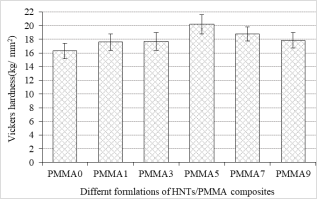
The influence of varying HNT concentrations on the VH of PMMA denture base composites is shown in
Table 4 and
Figure 2. Hardness was expressed in kg/mm
2 (mean ± standard deviation). The PMMA0 exhibited a baseline hardness of 16.28 ± 1.57 kg/mm
2. Incorporation of HNTs produced a progressive increase in hardness up to 5 wt% loading, with PMMA1 recording 17.60 ± 1.14 kg/mm
2 and PMMA3 reaching 17.71 ± 1.26 kg/mm
2. PMMA5 exhibited the greatest hardness (20.20 ± 1.21 kg/mm
2), reflecting the highest enhancement across all tested groups.
At concentrations above this level, the hardness decreased, with PMMA7 recording 18.77 ± 1.11 kg/mm2 and PMMA9 registering 17.85 ± 1.34 kg/mm2, although both remained higher than the control. Statistical analysis confirmed significant differences among all groups (p < 0.001). This indicates that varying HNT loadings significantly affect the hardness of PMMA composites. In summary, the results show that moderate HNT incorporation enhances VH and peak reinforcement was observed at 5 wt% loading.
Table 4. Summary of mean VH values with standard deviations and sample counts.
Group | HNT (wt%) | n | VH (Kg/mm2), Mean ± SD |
PMMA0 | 0 | 10 | 16.28 ± 1.57 |
PMMA1 | 1 | 10 | 17.60 ± 1.14 |
PMMA3 | 3 | 10 | 17.71 ± 1.26 |
PMMA5 | 5 | 10 | 20.20 ± 1.21 |
PMMA7 | 7 | 10 | 18.77 ± 1.11 |
PMMA9 | 9 | 10 | 17.85 ± 1.34 |
Figure 1. Effect of different HNT loadings on VH of PMMA composites.
3.4. Fracture Surface Morphology of PMMA/HNT Composites
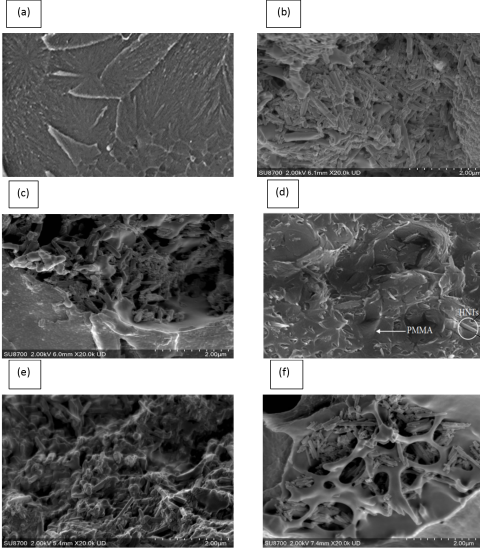
FESEM analysis revealed distinct changes in the fracture morphology of PMMA composites with increasing HNT content, as shown in
Figure 3. The PMMA0 exhibited relatively smooth fracture surfaces containing microcracks and voids, indicating brittle fracture behaviour. In contrast, PMMA1 and PMMA3 exhibited rougher, more irregular fracture surfaces, suggesting improved nanotube dispersion and stronger filler-matrix interactions.
Among all groups, PMMA5 exhibited the most compact and homogeneous microstructure, with minimal nanotube agglomeration and clear evidence of crack bridging and nanotube pull-out. At higher HNT loadings (PMMA7 and PMMA9), the fracture surfaces showed pronounced nanotube agglomeration, void formation, and irregular morphology, indicating poorer filler dispersion.
Figure 3. FESEM micrographs of PMMA/HNT composites containing (a) 0 wt.% HNT, (b) 1 wt.% HNT, (c) 3 wt.% HNT, (d) 5 wt.% HNT, (e) 7 wt.% HNT, and (f) 9 wt.% HNT.
4. Discussion
The FTIR findings support surface modification following γ-MPS treatment. The bands associated with Si-O-Si, Si-O-C, C=C and C=O groups are consistent with the presence of silane-derived functional groups on the treated HNTs. Incorporating γ-MPS may improve compatibility between the HNT surface and the PMMA matrix because the methacrylate functionality of γ-MPS can interact with the polymerising MMA phase, potentially improving filler–matrix adhesion.
The FESEM and EDX findings supported the FTIR results by demonstrating successful surface functionalisation. Increased silicon content suggests effective silane coating, which promotes better filler dispersion, stronger interfacial bonding, and more efficient stress transfer within the composite.
These findings agree with previous studies reporting that silane-treated HNTs improve filler dispersion, interfacial adhesion, and the mechanical performance of PMMA nanocomposites
| [24] | Paz E, Ballesteros Y, Forriol F, et al. Graphene and graphene oxide functionalisation with silanes for advanced dispersion and reinforcement of PMMA-based bone cements. Materials Science and Engineering C 2019; 104: 1-12.
https://doi.org/10.1016/j.msec.2019.109946 |
| [25] | Olonisakin K, fan, M, X-XZ, RL, LW, ZW, & WY. Key Improvements in Interfacial Adhesion and Dispersion of Fibers/Fillers in Polymer Matrix Composites; Focus on PLA Matrix Composites. Compos Interfaces 2022; 29: 1071-1120. https://doi.org/10.1080/09276440.2021.1878441 |
| [26] | Ghosh SK, Das TK, Ganguly S, et al. Silane functionalization of sodium montmorillonite and halloysite (HNT) nanoclays by ‘grafting to’ method to improve physico-mechanical and barrier properties of LLDPE/clay nanocomposites. Polym Bull 2023; 80: 4307-4335.
https://doi.org/10.1007/s00289-022-04281-4 |
| [27] | Niranjana VS, Ponnan S, Mukundan A, et al. Emerging Trends in Silane-Modified Nanomaterial-Polymer Nanocomposites for Energy Harvesting Applications. Polymers 2025; 17: 1-49. https://doi.org/10.3390/polym17101416 |
[24-27]
.
The null hypothesis was not upheld, as both FS and VH of PMMA resins varied following HNT reinforcement. Key factors influencing filler incorporation include its distribution within the polymer matrix, particle morphology and size, and the extent of interfacial bonding with the matrix
| [25] | Olonisakin K, fan, M, X-XZ, RL, LW, ZW, & WY. Key Improvements in Interfacial Adhesion and Dispersion of Fibers/Fillers in Polymer Matrix Composites; Focus on PLA Matrix Composites. Compos Interfaces 2022; 29: 1071-1120. https://doi.org/10.1080/09276440.2021.1878441 |
| [28] | Sabri BA, Satgunam M, Abreeza NM, et al. A review on enhancements of PMMA Denture Base Material with Different Nano-Fillers. Cogent Eng 2021; 8: 1-25.
https://doi.org/10.1080/23311916.2021.1875968 |
| [29] | Kundie F, Azhari CH, Muchtar A, et al. Effects of filler size on the mechanical properties of polymer-filled dental composites: A review of recent developments. Journal of Physical Science 2018; 29: 141-165. https://doi.org/10.21315/jps2018.29.1.10 |
[25, 28, 29]
. For effective reinforcement, the filler is sufficiently dispersed to create a uniform mixture and penetrate between linear macromolecular chains, thereby limiting their mobility. This inhibited the development of a heterogeneous mixture and allowed the nanoparticles to occupy pores between the polymer particles. Consequently, polymer chain mobility was reduced.
Incorporating HNTs significantly improved both the FS and VH of PMMA denture base composites, with the optimum performance achieved at 5 wt% HNT loading. The control PMMA exhibited the lowest FS (77.5 MPa) and VH (16.28 kg/mm
2), which is consistent with the inherent limitations of conventional PMMA and values reported in previous studies
. The gradual increase in FS and VH at 1 wt% and 3 wt% HNTs suggests that well-dispersed nanotubes enhanced stress transfer, strengthened the filler-matrix interface, and restricted polymer chain mobility, thereby improving mechanical performance. Similar findings have been reported for HNT- and nanoparticle-reinforced PMMA composites
| [31] | Hu Y, Ding JL, Chen Y. Effects of nanofiller geometries and interfacial properties on the mechanical performance of polymer nanocomposites—A numerical study. Polymers and Polymer Composites 2021; 29: S19-S35.
https://doi.org/10.1177/0967391120983636 |
| [32] | Mousavi SR, Estaji S, Paydayesh A, et al. A review of recent progress in improving the fracture toughness of epoxy-based composites using carbonaceous nanofillers. Polymer Composites 2022; 43: 1871-1886. https://doi.org/10.1002/pc.26518 |
| [33] | Alshahrani FA, AlGhamdi M, Alghamdi D, et al. Nanocomposite Provisional Resin: Effect of Nanoparticles Addition on the Physical Properties and Antimicrobial Activities In Vitro. Prosthesis 2024; 6: 952-969.
https://doi.org/10.3390/prosthesis6040069 |
[31-33]
.
The optimum enhancement was achieved at 5 wt.% HNTs, where FS rose to 98.1 MPa, surpassing the ISO threshold for denture base polymers, while VH reached 20.20 kg/mm
2. FS was evaluated in accordance with ISO 20795 1:2013, which specifies a minimum requirement of 65 MPa for Type I denture base polymers. VH was also measured as a supplementary property, although the standard does not specify a minimum requirement. This improvement is attributed to the uniform dispersion of HNTs, their high aspect ratio, and strong interfacial bonding, which collectively increased matrix stiffness and resistance to bending and surface deformation
| [34] | Gray-Wannell N, Cubillas P, Aslam Z, et al. Morphological features of halloysite nanotubes as revealed by various microscopies. Clay Miner 2023; 58: 395-407.
https://doi.org/10.1180/clm.2023.37 |
| [35] | VR J, KN R. An Investigation on the Effect of the Surface Modifications and HNTs loading on the Cure behaviours, Abrasion Resistance, Mechanical and Morphological Properties of NR/EPDM. 2023; 1-38. https://doi.org/10.21203/rs.3.rs-3335231/v1 |
| [36] | Aldwimi I, Alhareb A, Akil H, et al. Effect of Hybrid Nanofillers on the Mechanical Characteristics of Polymethyl Methacrylate Denture Base Composite. Composite Materials 2024; 8: 30-43. https://doi.org/10.11648/j.cm.20240802.12 |
| [37] | Idumah CI, Hassan A, Ogbu J, et al. Recently emerging advancements in halloysite nanotubes polymer nanocomposites. Compos Interfaces 2018; 26: 751-824.
https://doi.org/10.1080/09276440.2018.1534475 |
[34-37]
. However, increasing the HNT concentration to 7 wt.% and 9 wt.% reduced both FS and VH, attributed to nanotube agglomeration that generated weak interfacial zones and defects, thereby hindering stress transfer. Previous investigations have likewise reported similar tendencies
| [31] | Hu Y, Ding JL, Chen Y. Effects of nanofiller geometries and interfacial properties on the mechanical performance of polymer nanocomposites—A numerical study. Polymers and Polymer Composites 2021; 29: S19-S35.
https://doi.org/10.1177/0967391120983636 |
| [38] | Guchait A, Saxena A, Chattopadhyay S, et al. Influence of Nanofillers on Adhesion Properties of Polymeric Composites. ACS Omega 2022; 7: 3844-3859.
https://doi.org/10.1021/acsomega.1c05448 |
[31, 38]
. The present findings indicate that 5 wt.% HNT provides an effective balance between filler incorporation and mechanical reinforcement. Nevertheless, several limitations should be acknowledged. The present study was conducted under controlled laboratory conditions and did not assess the effects of prolonged ageing or cyclic fatigue. Wear resistance, fracture toughness, and biocompatibility were also not evaluated. Although FESEM provided qualitative evidence of HNT dispersion and agglomeration, quantitative assessment of filler dispersion was not performed. These limitations should be addressed in future studies to provide a more comprehensive evaluation of the long-term mechanical performance and clinical applicability of γ-MPS-treated HNT-reinforced PMMA denture-base composites.
The FESEM analysis supported the mechanical findings by showing that the PMMA composite containing 5 wt% HNT exhibited a compact and homogeneous fracture surface, indicating good nanotube dispersion and strong interfacial bonding. This promoted effective stress transfer and enhanced crack resistance, thereby improving fracture behaviour, in line with earlier findings on silane-treated HNT-reinforced PMMA composites
| [24] | Paz E, Ballesteros Y, Forriol F, et al. Graphene and graphene oxide functionalisation with silanes for advanced dispersion and reinforcement of PMMA-based bone cements. Materials Science and Engineering C 2019; 104: 1-12.
https://doi.org/10.1016/j.msec.2019.109946 |
| [25] | Olonisakin K, fan, M, X-XZ, RL, LW, ZW, & WY. Key Improvements in Interfacial Adhesion and Dispersion of Fibers/Fillers in Polymer Matrix Composites; Focus on PLA Matrix Composites. Compos Interfaces 2022; 29: 1071-1120. https://doi.org/10.1080/09276440.2021.1878441 |
[24, 25]
. In contrast, the 7 wt.% and 9 wt.% HNT groups exhibited evident nanotube agglomeration and voids, creating stress concentration sites that diminished reinforcement efficiency and compromised mechanical performance, a phenomenon also noted in earlier research
| [30] | Alhotan A, Yates J, Zidan S, et al. Flexural strength and hardness of filler-reinforced pmma targeted for denture base application. Materials 2021; 14: 1-14.
https://doi.org/10.3390/ma14102659 |
| [31] | Hu Y, Ding JL, Chen Y. Effects of nanofiller geometries and interfacial properties on the mechanical performance of polymer nanocomposites—A numerical study. Polymers and Polymer Composites 2021; 29: S19-S35.
https://doi.org/10.1177/0967391120983636 |
[30, 31]
. Overall, these findings confirm that 5 wt% HNT is the optimum concentration for improving the fracture resistance and durability of PMMA denture base composites
| [32] | Mousavi SR, Estaji S, Paydayesh A, et al. A review of recent progress in improving the fracture toughness of epoxy-based composites using carbonaceous nanofillers. Polymer Composites 2022; 43: 1871-1886. https://doi.org/10.1002/pc.26518 |
[32]
.
5. Conclusions
Silane-treated HNTs enhanced the mechanical performance of heat-polymerised PMMA denture-base composites, with FS and VH increasing up to an optimum 5 wt.% loading. This improvement stemmed from effective dispersion and strong filler-matrix interaction, promoting stress transfer and restricting polymer-chain mobility. At higher concentrations, agglomeration and stress-concentrating defects reduced performance. Overall, 5 wt.% HNT offered the best balance between reinforcement and structural integrity. Future work should assess water ageing, fatigue, wear, residual monomer release, biocompatibility, and quantitative dispersion to establish long-term performance and clinical applicability.
Abbreviations
PMMA | Polymethyl Methacrylate |
DBM | Denture Base Material |
BPO | Benzoyl Peroxide |
MMA | Methyl Methacrylate |
EGDMA | Ethylene Glycol Dimethacrylate |
HNTs | Halloysite Nanotubes |
NP | Nanoparticle |
FESEM | Field Emission Scanning Electron Microscopy |
SEM | Scanning Electron Microscopy |
FS | Flexural Strength |
VH | Vickers Hardness |
SENB | Single-Edge Notched Bending |
γ-MPS | 3-(Trimethoxysilyl) Propyl Methacrylate |
ASTM | American Society for Testing and Materials |
ANOVA | One-Way Analysis of Variance |
EDX | Energy-Dispersive X-ray Analysis |
FTIR | Fourier Transform Infrared Spectroscopy |
SD | Standard Deviation |
Acknowledgments
The authors gratefully acknowledge the Ministry of Higher Education, Malaysia, the Ministry of Higher Education, Libya, and Lincoln University College for their academic support throughout this Master's research. They also sincerely thank Universiti Sains Malaysia for its invaluable technical support and assistance during the experimental phase of this study.
Author Contributions
Rugaia Sharef: Conceptualisation, Data curation, Methodology, Writing – original draft, Writing – review & editing
William Thomas: Methodology, Supervision, Validation, Writing – review & editing
Hazizan Akil: Methodology, Resources, Supervision, Validation, Writing – review & editing
Issam Mohamed Aldwimi: Resources, Supervision, Validation, Writing – review & editing
Conflicts of Interest
The authors declare no conflicts of interest.
References
| [1] |
Abozaid D, Azab A, Bahnsawy MA, et al. Bioactive restorative materials in dentistry: a comprehensive review of mechanisms, clinical applications, and future directions. Odontology 2025; 114: 1–29.
https://doi.org/10.1007/s10266-025-01162-w
|
| [2] |
Rathee G, Bartwal G, Rathee J, et al. Emerging Multimodel Zirconia Nanosystems for High-Performance Biomedical Applications. Advanced NanoBiomed Research 2021; 1: 1–45.
https://doi.org/10.1002/anbr.202100039
|
| [3] |
Eftekhar Ashtiani R, Alam M, Tavakolizadeh S, et al. The Role of Biomaterials and Biocompatible Materials in Implant-Supported Dental Prosthesis. Evidence-based Complementary and Alternative Medicine 2021; 2021: 1–9.
https://doi.org/10.1155/2021/3349433
|
| [4] |
Al-Taie THK. CENTRAL ASIAN JOURNAL OF MEDICAL AND NATURAL SCIENCES Future Directions in Restorative and Aesthetic Dentistry: Innovations, Digital Advancements, and Biomimetic Approaches. Epub ahead of print 2025.
https://doi.org/0000-0002-3752-6511
|
| [5] |
Zafar MS. Prosthodontic applications of polymethyl methacrylate (PMMA): An update. Polymers 2020; 12: 1–35.
https://doi.org/10.3390/polym12102299
|
| [6] |
Pituru SM, Greabu M, Totan A, et al. A review on the biocompatibility of PMMA-Based dental materials for interim prosthetic restorations with a glimpse into their modern manufacturing techniques. Materials 2020; 13: 1–14.
https://doi.org/10.3390/ma13132894
|
| [7] |
Díez-Pascual, Ana M. PMMA-Based Nanocomposites for Odontology Applications: A State-of-the-Art. International Journal of Molecular Sciences 2022; 23: 1–19.
https://doi.org/10.3390/ijms231810288
|
| [8] |
Alqutaibi AY, Baik A, Almuzaini SA, et al. Polymeric Denture Base Materials: A Review. Polymers 2023; 15: 1–27.
https://doi.org/10.3390/polym15153258
|
| [9] |
Burcea A, Bănățeanu A-M, Poalelungi CV, et al. ENHANCED PROPERTIES AND MULTIFACETED APPLICATIONS OF POLYMETHYL METHACRYLATE (PMMA) IN MODERN MEDICINE AND DENTISTRY. Romanian Journal of Oral Rehabilitation 2024; 16: 108–123.
https://doi.org/10.62610/RJOR.2024.4.16.11
|
| [10] |
Saif K. Mezzal, Al-Azzawi Zaid, Najim Khalid B. Effect of discarded steel fibers on impact resistance, flexural toughness and fracture energy of high-strength self-compacting concrete exposed to elevated temperatures. Fire Saf J 2021; 121: 1–16.
https://doi.org/10.1016/j.firesaf.2020.103271
|
| [11] |
Abid SR, Murali G, Ahmad J, et al. Repeated Drop-Weight Impact Testing of Fibrous Concrete: State-Of-The-Art Literature Review, Analysis of Results Variation and Test Improvement Suggestions. Materials 2022; 15: 1–22.
https://doi.org/10.3390/ma15113948
|
| [12] |
Favero R, Scattolin A, Barone M, et al. A Comprehensive Review of Treatment Plans for Marginal Enamel Fractures in Anterior Teeth. Biomimetics 2024; 9: 1–11.
https://doi.org/10.3390/biomimetics9120770
|
| [13] |
Müller-Mundt G, Pott PC, Prinz L, et al. Patients’ trajectory from tooth loss to dental rehabilitation and living with implant-supported dentures – a qualitative interview study. BMC Oral Health 2025; 25: 1–15.
https://doi.org/10.1186/s12903-025-06072-5
|
| [14] |
Le Bars P, Bandiaky ON, Le Guéhennec L, et al. Different Polymers for the Base of Removable Dentures? Part I: A Narrative Review of Mechanical and Physical Properties. Polymers 2023; 15: 1–18.
https://doi.org/10.3390/polym15173495
|
| [15] |
Majeed HF, Hamad TI, Bairam LR. Enhancing 3D-printed denture base resins: A review of material innovations. Science Progress 2024; 107: 1–20.
https://doi.org/10.1177/00368504241263484
|
| [16] |
Alhotan A, Yates J, Zidan S, et al. Assessing fracture toughness and impact strength of PMMA reinforced with nano-particles and fibre as advanced denture base materials. Materials 2021; 14: 1–15.
https://doi.org/10.3390/ma14154127
|
| [17] |
Musa AA, Bello A, Adams SM, et al. Nano-Enhanced Polymer Composite Materials: A Review of Current Advancements and Challenges. Polymers 2025; 17: 1–39.
https://doi.org/10.3390/polym17070893
|
| [18] |
James Njuguna, Sophia Sachse HZ, Veronica Marchante Rodriguez, et al. Nanomaterials, nanofillers, and nanocomposites: types and properties. Health and Environmental Safety of Nanomaterials (Second Edition) 2021; 3–37.
https://doi.org/10.1016/B978-0-12-820505-1.00011-0
|
| [19] |
Harito C, Bavykin D V., Yuliarto B, et al. Polymer nanocomposites having a high filler content: Synthesis, structures, properties, and applications. Nanoscale 2019; 11: 4653–4682.
https://doi.org/10.1039/c9nr00117d
|
| [20] |
Waseem M, Zhang X, Wang WB, et al. Lightweight and high EMI shielding performed ZrB2-SiC/CF@Epoxy-Fe3O4 composites with carbonated cotton fibers. J Alloys Compd 2025; 1030: 1–9.
https://doi.org/10.1016/j.jallcom.2025.180915
|
| [21] |
Zhai W, Bai L, Zhou R, et al. Recent Progress on Wear-Resistant Materials: Designs, Properties, and Applications. Advanced Science 2021; 8: 1–29.
https://doi.org/10.1002/advs.202003739
|
| [22] |
Fan Q, Waseem M, Fu L, et al. Supercritical CO2 foamed PA12 and PA12/aramid fiber composites. Journal of Supercritical Fluids 2026; 235: 1–11.
https://doi.org/10.1016/j.supflu.2026.107004
|
| [23] |
Waseem M, Xie Y, Yu K, et al. Lightweight ZnO/Carbonated Cotton Fiber Nanocomposites for Electromagnetic Interference Applications: Preparation and Properties. Polymers (Basel); 16. Epub ahead of print 1 January 2024.
https://doi.org/10.3390/polym16010116
|
| [24] |
Paz E, Ballesteros Y, Forriol F, et al. Graphene and graphene oxide functionalisation with silanes for advanced dispersion and reinforcement of PMMA-based bone cements. Materials Science and Engineering C 2019; 104: 1-12.
https://doi.org/10.1016/j.msec.2019.109946
|
| [25] |
Olonisakin K, fan, M, X-XZ, RL, LW, ZW, & WY. Key Improvements in Interfacial Adhesion and Dispersion of Fibers/Fillers in Polymer Matrix Composites; Focus on PLA Matrix Composites. Compos Interfaces 2022; 29: 1071-1120.
https://doi.org/10.1080/09276440.2021.1878441
|
| [26] |
Ghosh SK, Das TK, Ganguly S, et al. Silane functionalization of sodium montmorillonite and halloysite (HNT) nanoclays by ‘grafting to’ method to improve physico-mechanical and barrier properties of LLDPE/clay nanocomposites. Polym Bull 2023; 80: 4307-4335.
https://doi.org/10.1007/s00289-022-04281-4
|
| [27] |
Niranjana VS, Ponnan S, Mukundan A, et al. Emerging Trends in Silane-Modified Nanomaterial-Polymer Nanocomposites for Energy Harvesting Applications. Polymers 2025; 17: 1-49.
https://doi.org/10.3390/polym17101416
|
| [28] |
Sabri BA, Satgunam M, Abreeza NM, et al. A review on enhancements of PMMA Denture Base Material with Different Nano-Fillers. Cogent Eng 2021; 8: 1-25.
https://doi.org/10.1080/23311916.2021.1875968
|
| [29] |
Kundie F, Azhari CH, Muchtar A, et al. Effects of filler size on the mechanical properties of polymer-filled dental composites: A review of recent developments. Journal of Physical Science 2018; 29: 141-165.
https://doi.org/10.21315/jps2018.29.1.10
|
| [30] |
Alhotan A, Yates J, Zidan S, et al. Flexural strength and hardness of filler-reinforced pmma targeted for denture base application. Materials 2021; 14: 1-14.
https://doi.org/10.3390/ma14102659
|
| [31] |
Hu Y, Ding JL, Chen Y. Effects of nanofiller geometries and interfacial properties on the mechanical performance of polymer nanocomposites—A numerical study. Polymers and Polymer Composites 2021; 29: S19-S35.
https://doi.org/10.1177/0967391120983636
|
| [32] |
Mousavi SR, Estaji S, Paydayesh A, et al. A review of recent progress in improving the fracture toughness of epoxy-based composites using carbonaceous nanofillers. Polymer Composites 2022; 43: 1871-1886.
https://doi.org/10.1002/pc.26518
|
| [33] |
Alshahrani FA, AlGhamdi M, Alghamdi D, et al. Nanocomposite Provisional Resin: Effect of Nanoparticles Addition on the Physical Properties and Antimicrobial Activities In Vitro. Prosthesis 2024; 6: 952-969.
https://doi.org/10.3390/prosthesis6040069
|
| [34] |
Gray-Wannell N, Cubillas P, Aslam Z, et al. Morphological features of halloysite nanotubes as revealed by various microscopies. Clay Miner 2023; 58: 395-407.
https://doi.org/10.1180/clm.2023.37
|
| [35] |
VR J, KN R. An Investigation on the Effect of the Surface Modifications and HNTs loading on the Cure behaviours, Abrasion Resistance, Mechanical and Morphological Properties of NR/EPDM. 2023; 1-38.
https://doi.org/10.21203/rs.3.rs-3335231/v1
|
| [36] |
Aldwimi I, Alhareb A, Akil H, et al. Effect of Hybrid Nanofillers on the Mechanical Characteristics of Polymethyl Methacrylate Denture Base Composite. Composite Materials 2024; 8: 30-43.
https://doi.org/10.11648/j.cm.20240802.12
|
| [37] |
Idumah CI, Hassan A, Ogbu J, et al. Recently emerging advancements in halloysite nanotubes polymer nanocomposites. Compos Interfaces 2018; 26: 751-824.
https://doi.org/10.1080/09276440.2018.1534475
|
| [38] |
Guchait A, Saxena A, Chattopadhyay S, et al. Influence of Nanofillers on Adhesion Properties of Polymeric Composites. ACS Omega 2022; 7: 3844-3859.
https://doi.org/10.1021/acsomega.1c05448
|
Cite This Article
-
APA Style
Sharef, R., Thomas, W., Akil, H., Aldwimi, I. M. (2026). Flexural Performance and Surface Hardness of
Filler-Modified PMMA Designed for Denture Base Applications. International Journal of Biomedical Materials Research, 14(1), 8-16. https://doi.org/10.11648/j.ijbmr.20261401.12
 Copy
|
Copy
|
 Download
ACS Style
Sharef, R.; Thomas, W.; Akil, H.; Aldwimi, I. M. Flexural Performance and Surface Hardness of
Filler-Modified PMMA Designed for Denture Base Applications. Int. J. Biomed. Mater. Res. 2026, 14(1), 8-16. doi: 10.11648/j.ijbmr.20261401.12
Copy
|
Download
AMA Style
Sharef R, Thomas W, Akil H, Aldwimi IM. Flexural Performance and Surface Hardness of
Filler-Modified PMMA Designed for Denture Base Applications. Int J Biomed Mater Res. 2026;14(1):8-16. doi: 10.11648/j.ijbmr.20261401.12
Copy
|
Download
-
@article{10.11648/j.ijbmr.20261401.12,
  author = {Rugaia Sharef and William Thomas and Hazizan Akil and Issam Mohamed Aldwimi},
  title = {Flexural Performance and Surface Hardness of
Filler-Modified PMMA Designed for Denture Base Applications},
  journal = {International Journal of Biomedical Materials Research},
  volume = {14},
  number = {1},
  pages = {8-16},
  doi = {10.11648/j.ijbmr.20261401.12},
  url = {https://doi.org/10.11648/j.ijbmr.20261401.12},
  eprint = {https://article.sciencepublishinggroup.com/pdf/10.11648.j.ijbmr.20261401.12},
  abstract = {Polymethyl methacrylate (PMMA) is widely used in denture base fabrication; however, its relatively low flexural strength (FS) and durability limit long-term clinical performance. Reinforcing with nanofillers such as Halloysite nanotubes (HNTs) has emerged as a promising strategy to enhance the material's mechanical properties. This study aimed to evaluate the effect of different HNT loadings on the FS and surface hardness (VH) of PMMA denture base composites. PMMA composites were prepared using a heat-polymerised resin reinforced with treated HNTs at concentrations of 0, 1, 3, 5, 7, and 9 wt.%. To achieve uniform dispersion, the nanofillers were ultrasonically dispersed in methyl methacrylate before conventional polymerisation; the filler distribution and the effectiveness of silane functionalisation were examined through morphological and microchemical characterisation using scanning electron microscopy (SEM) coupled with energy-dispersive X-ray spectroscopy (EDX). Mechanical performance was assessed by determining FS via the three-point bending test, while VH was measured using the Vickers hardness method. Statistical analysis one-way Analysis of Variance (ANOVA) followed by Tukey’s post hoc test, with significance set at p 2) observed at 5 wt% HNT loading, representing substantial improvements over unmodified PMMA. At higher concentrations (7-9 wt.%), a decline in properties was observed, attributed to nanoparticle agglomeration and reduced interfacial efficiency. HNT reinforcement effectively enhances the mechanical performance of PMMA denture base materials, with 5 wt.% identified as the optimal concentration. These findings support the potential application of HNT-reinforced PMMA to improve durability and clinical longevity of denture prostheses.},
 year = {2026}
}
Copy
|
Download
-
TY  - JOUR
T1  - Flexural Performance and Surface Hardness of
Filler-Modified PMMA Designed for Denture Base Applications
AU  - Rugaia Sharef
AU  - William Thomas
AU  - Hazizan Akil
AU  - Issam Mohamed Aldwimi
Y1  - 2026/09/30
PY  - 2026
N1  - https://doi.org/10.11648/j.ijbmr.20261401.12
DO  - 10.11648/j.ijbmr.20261401.12
T2  - International Journal of Biomedical Materials Research
JF  - International Journal of Biomedical Materials Research
JO  - International Journal of Biomedical Materials Research
SP  - 8
EP  - 16
PB  - Science Publishing Group
SN  - 2330-7579
UR  - https://doi.org/10.11648/j.ijbmr.20261401.12
AB  - Polymethyl methacrylate (PMMA) is widely used in denture base fabrication; however, its relatively low flexural strength (FS) and durability limit long-term clinical performance. Reinforcing with nanofillers such as Halloysite nanotubes (HNTs) has emerged as a promising strategy to enhance the material's mechanical properties. This study aimed to evaluate the effect of different HNT loadings on the FS and surface hardness (VH) of PMMA denture base composites. PMMA composites were prepared using a heat-polymerised resin reinforced with treated HNTs at concentrations of 0, 1, 3, 5, 7, and 9 wt.%. To achieve uniform dispersion, the nanofillers were ultrasonically dispersed in methyl methacrylate before conventional polymerisation; the filler distribution and the effectiveness of silane functionalisation were examined through morphological and microchemical characterisation using scanning electron microscopy (SEM) coupled with energy-dispersive X-ray spectroscopy (EDX). Mechanical performance was assessed by determining FS via the three-point bending test, while VH was measured using the Vickers hardness method. Statistical analysis one-way Analysis of Variance (ANOVA) followed by Tukey’s post hoc test, with significance set at p 2) observed at 5 wt% HNT loading, representing substantial improvements over unmodified PMMA. At higher concentrations (7-9 wt.%), a decline in properties was observed, attributed to nanoparticle agglomeration and reduced interfacial efficiency. HNT reinforcement effectively enhances the mechanical performance of PMMA denture base materials, with 5 wt.% identified as the optimal concentration. These findings support the potential application of HNT-reinforced PMMA to improve durability and clinical longevity of denture prostheses.
VL  - 14
IS  - 1
ER  -
Copy
|
Download


 Share This Article
 Twitter
 Linked In
 Facebook